
Tour Description
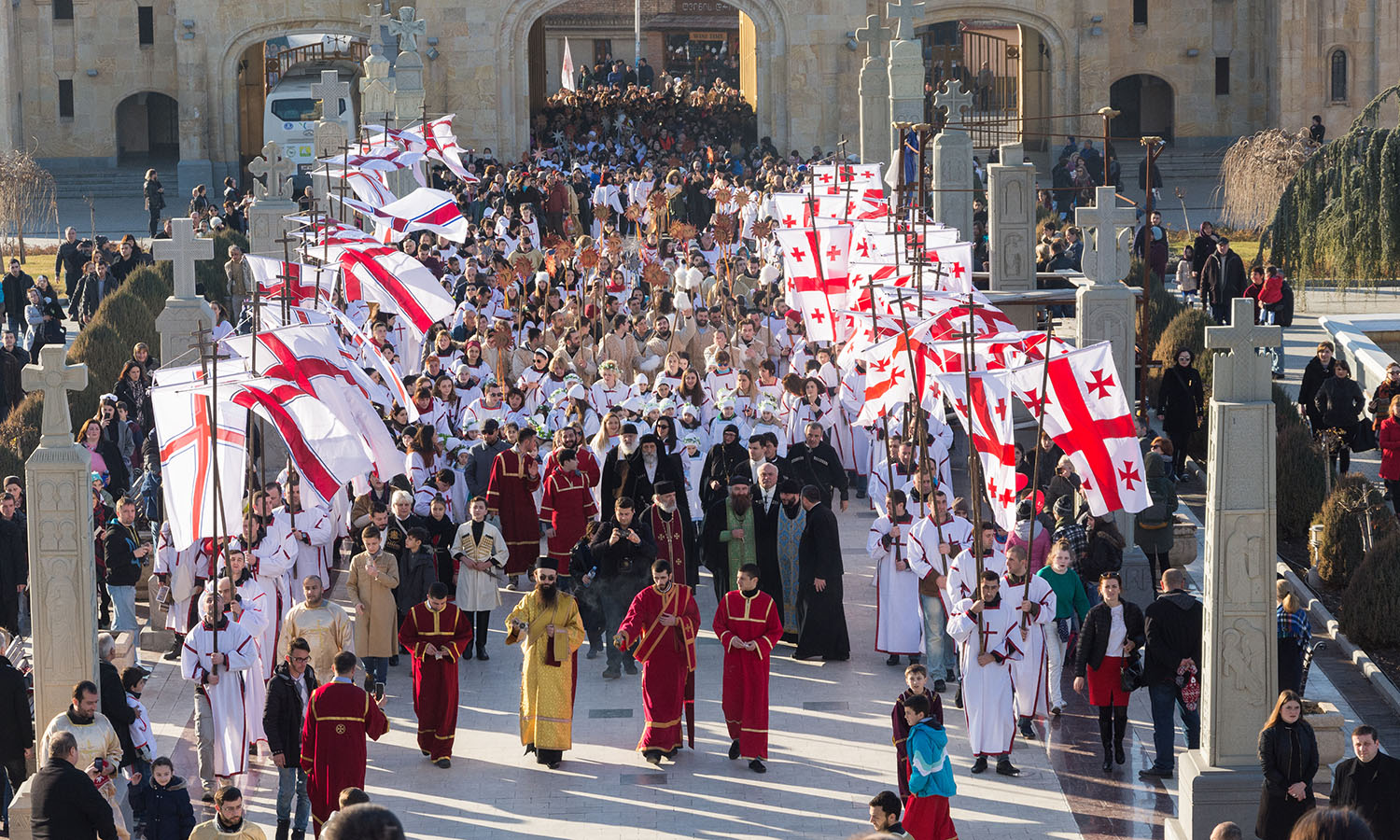
Georgia belongs to the chosen countries that have extensive relationships with the Biblical world. This is the country preserves the great treasure of Old Testament – the robe of Elijah the Tishbite and greatest sacred object of Christianity – mantle of our God and Lord, Jesus Christ. In this tour you will have the chance to visit the temples and monasteries of ancient Christian country, where there are preserved greatest sacred things of the period of Old Testament and those of Christian Georgia, as well as the miraculous icons. You will view unique architecture of the temples, their beautiful paintings, get familiar with original culture of the nation that has maintained these attractions for the world. You will observe preparations for the Easter and ancient method of dying of the eggs, also taste the kvevri wine made by the monks based on ancient Georgian traditions and technology (UNESCO Intangible Cultural Monument) and fully experience the charm of this ancient country.
Tour Highlights
- You will explore the sites of interest of Old Tbilisi.
- You will visit Davit Gareji, beautiful rock-cut monastery complex amidst the desert.
- You will view Georgian wine cellar and taste kvevri wine made based on 8000-year traditions.
- You will explore architecture and wall painting of amazing Gremi and Alaverdi temples.
- You will taste Georgian kvevri wine made by the monks
- You will view architectural complexes of Nekresi, Ikalto and Shuamta monasteries
- Explore Mtskheta, ancient capital city of Georgia and view Jvari and Svetitskhoveli temples.
- You will view 6th century Monastery of Shiomghvime and fortified city of Ananuri of 16th – 18th century
- You will explore Gelati Monastery Complex and enjoy beauty of Bagrati Cathedral
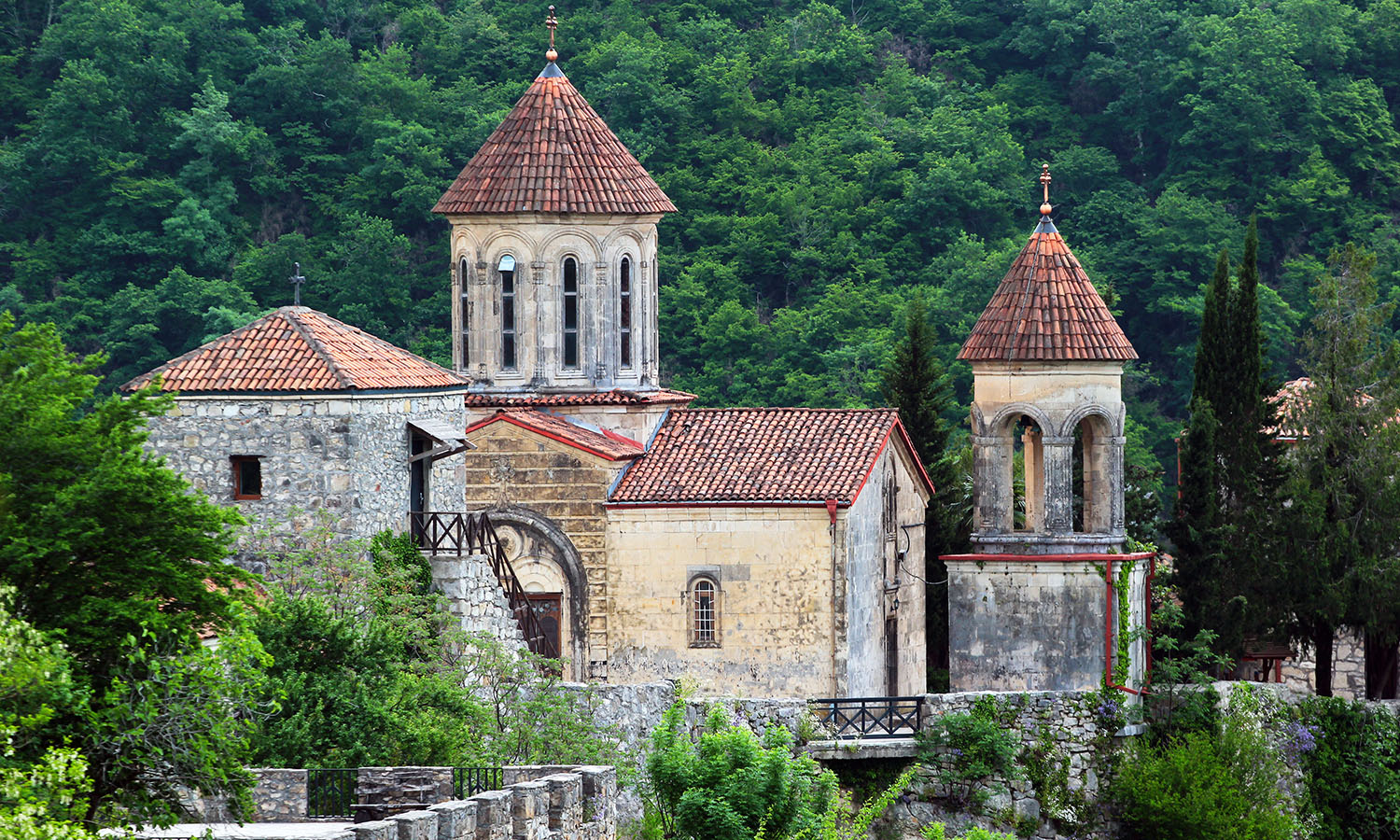
- View Motsameta Monastery of 8th century, significant monument of Georgian culture
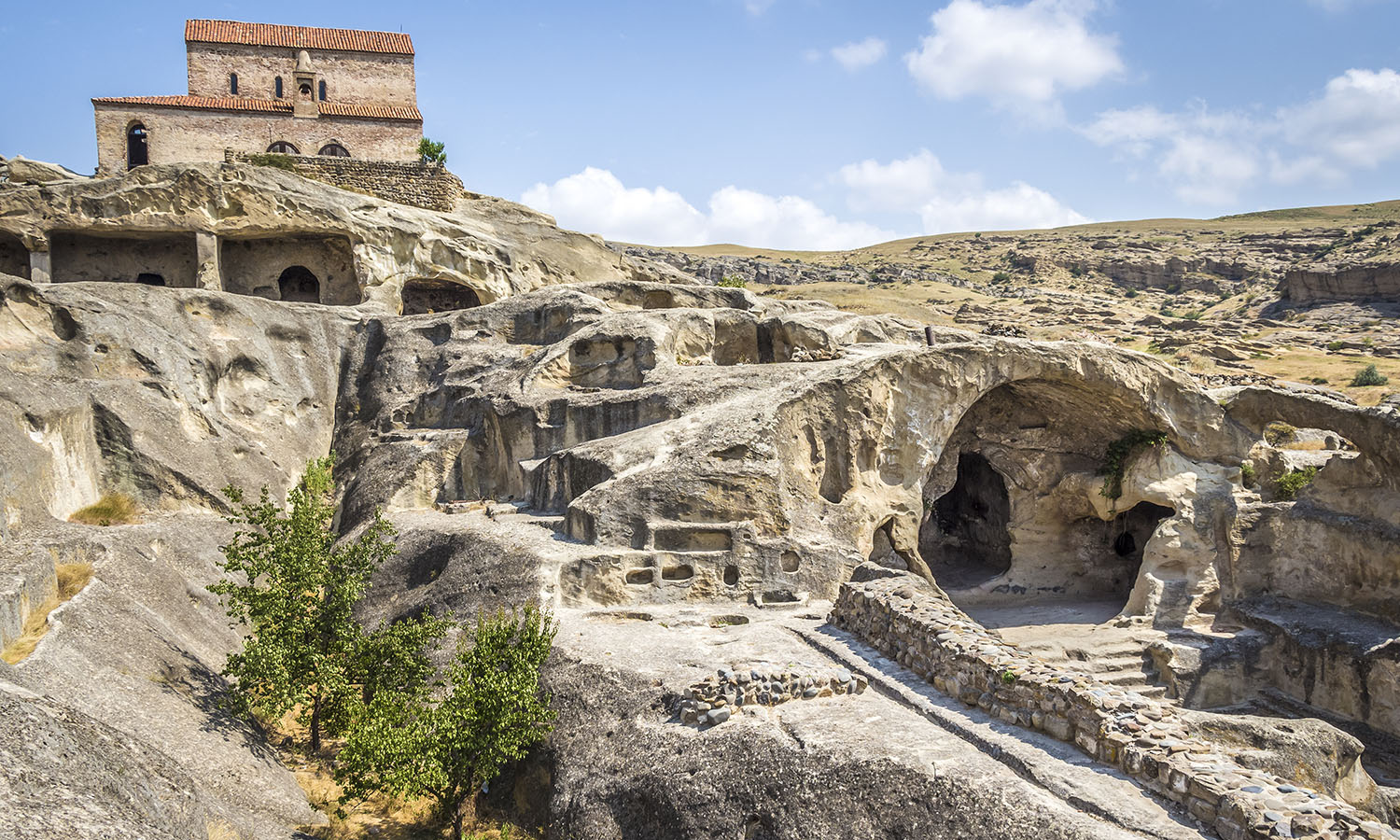
- Visit ancient cave town of Uplistsikhe
Gallery




Travel to Georgia (Tbilisi)
At arrival local representative of the company will meet you and deliver to the hotel on the company’s car.
Tbilisi
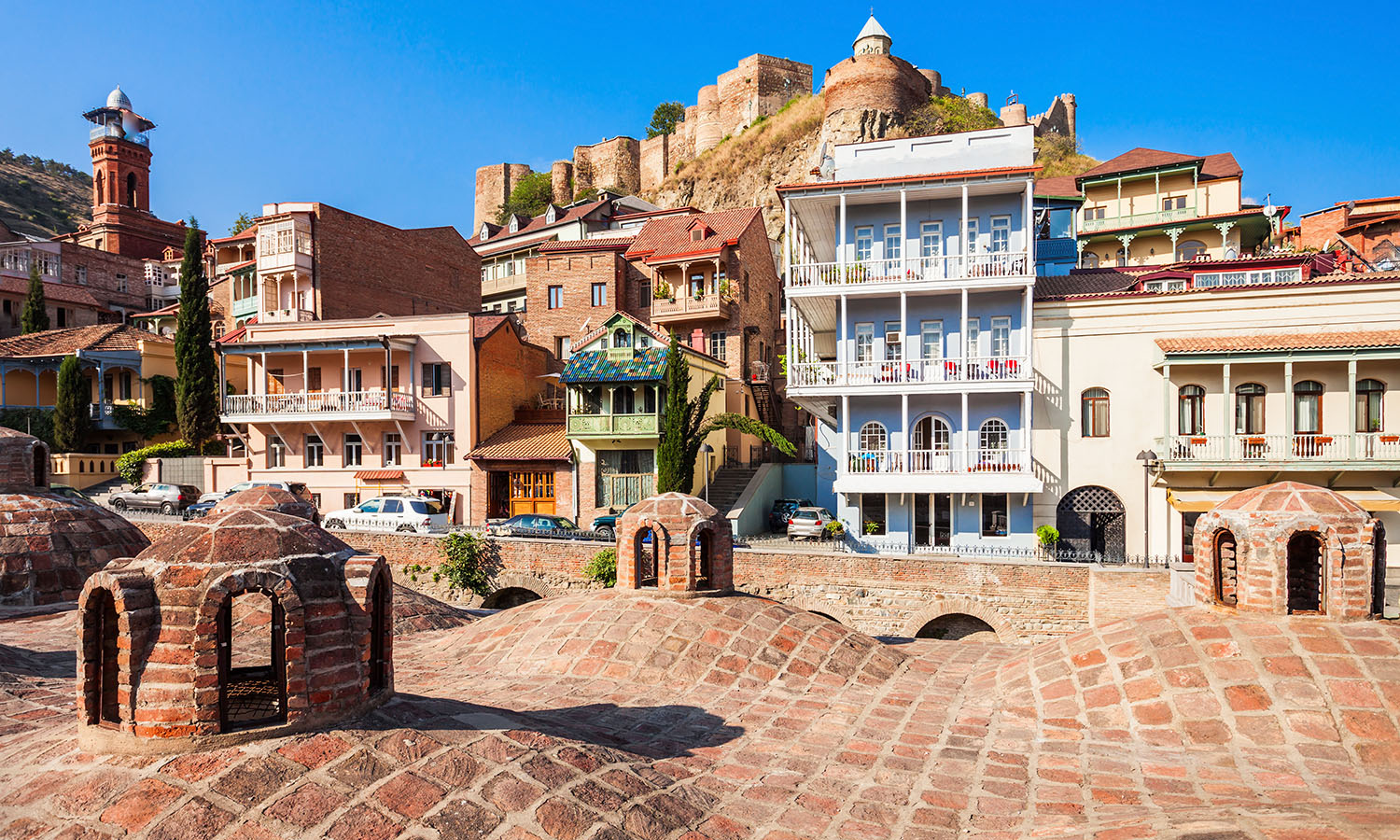
You will explore Old Tbilisi with its old narrow streets, houses with overhanging balconies painted in different colors and decorated with incredible ornaments. You will visit Christian churches, synagogue, mosque located side by side and sense the spirit of old town. You will view Narikala Fortress being the outpost and main citadel of the city for many centuries and panoramic view of Old Tbilisi will leave indeed deep impression. After descending from the fortress you will find yourself in Abanitubani, at the bathes with natural geodesic sulfur waters that delighted the travellers from all over the world for many centuries. You will visit the National Museum, to see the exhibits dated back starting from antiquity and epoch of Colchis creating deep impression about brilliance of Georgia. You will have a walk along Rustaveli Avenue.
Tbilisi – Davit Gareji – Sighnaghi (240 km)
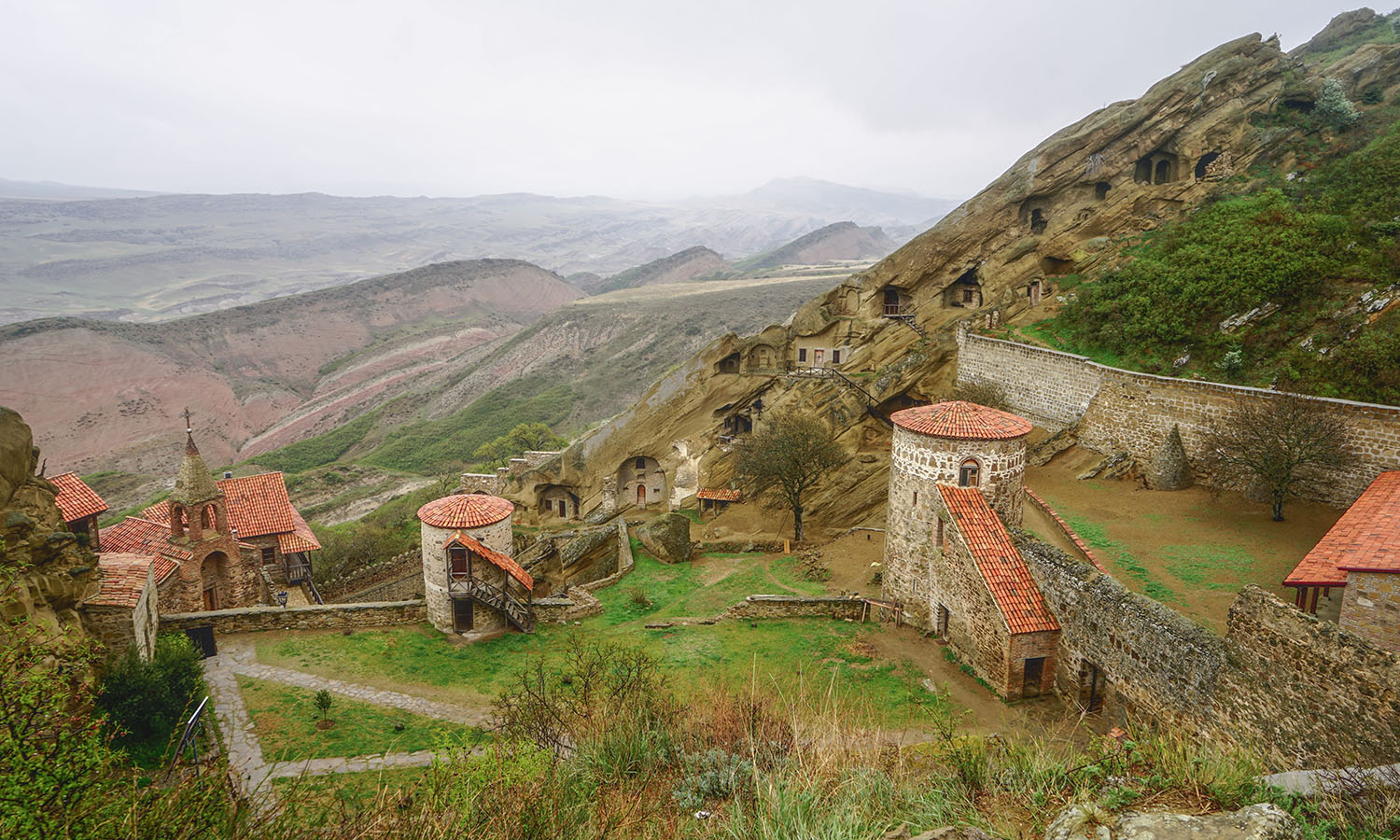
After the breakfast in the morning you will travel to 4th century Davit Gareji, one of the outstanding religious-cultural centers of Georgia of feudal period, as well as the monastic cave complex. Even today it impresses the viewers with high creative value of construction art and painting. In Davit Gareji you will visit the ancient monuments of the complex – Lavra and Udabno monasteries. You will view the rock-hewn churches, cells of the hermits, refectory and premises; as well as rainwater collection system artificially cut in the rocks, with its inlet ditches and water reservoirs. You will view the main structures of the complex, Transfiguration and Godmother churches, where you will find the beautiful original paintings of 10th century. In Davit Gareji the “Stone of Thank” brought by Holy Father Davit of Gareji from Jerusalem is regarded as sacred object there, it is placed on the grave of Davit of Gareji and it is well-known for its miraculous nature.
From Davit Gareji you will head to Sighnaghi and on your way there you will visit the farmer’s family, where you will taste the kvevri wine made based on 8000-year traditions and enjoy delicious family dinner.
Night stay in Sighnaghi.
Sighnaghi – Nekresi – Gremi – Alaverdi – Ikalto – Shuamta – Tbilisi (228 km)
You will visit Nekresi Monastery Complex which includes several monuments of Georgian architecture, of which small basilica of 2nd half of 4th century is one of the oldest churches in Georgia. Nekresi is one of the favorite places of prayer for the Georgians.
Further you will visit the medieval residence of Kakheti kings (1466-1614), fortified city of Gremi, the political, economic and educational center in the past.
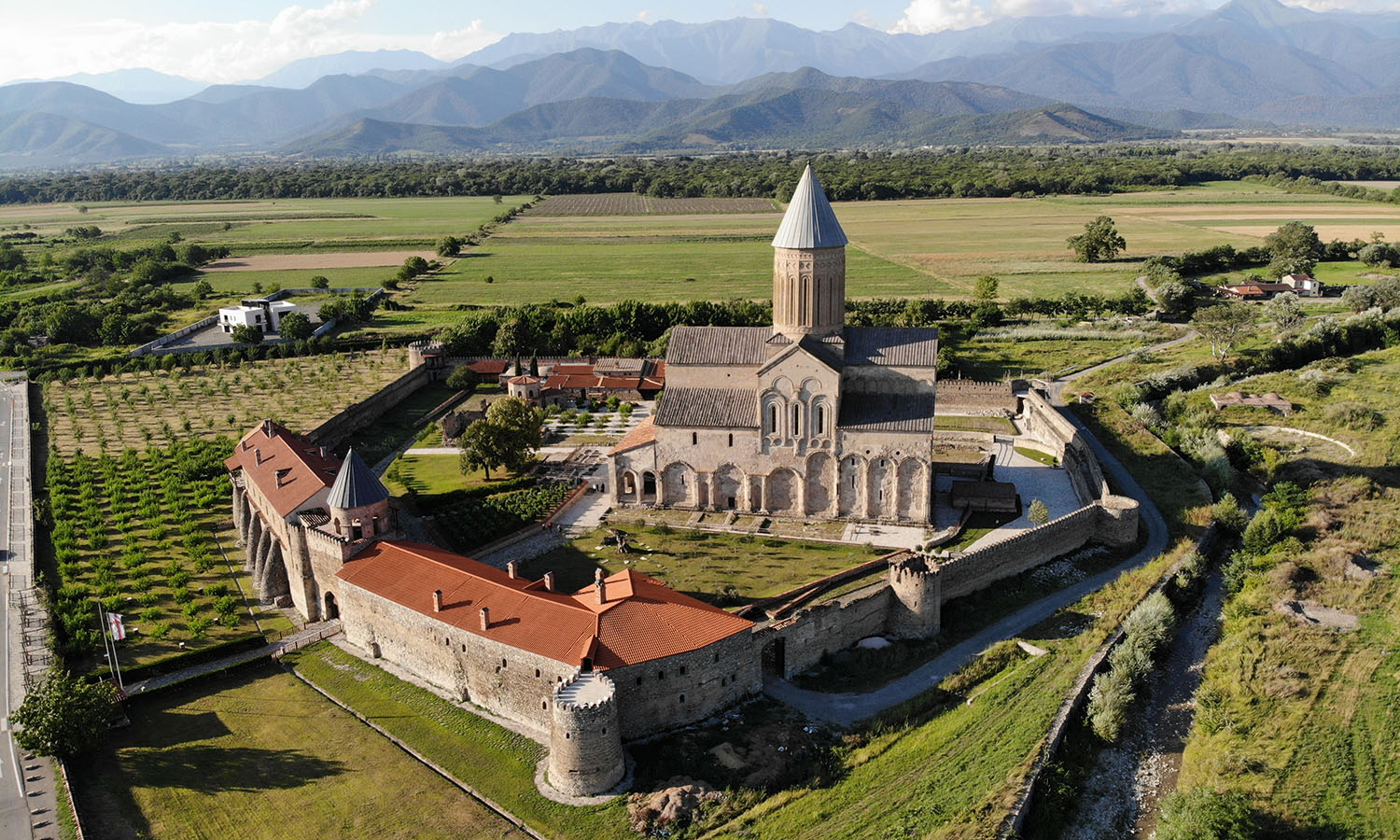
Further you will visit Alaverdi Cathedral, a beautiful sample of medieval Georgian architecture, with the roof made of blue tiles, located on green Alazani valley. Complex surrounded with the wall includes various structures. Of them, the centuries-old wine cellar deserves special attention. There you will taste the delicious wine made by the monks in kvevri.
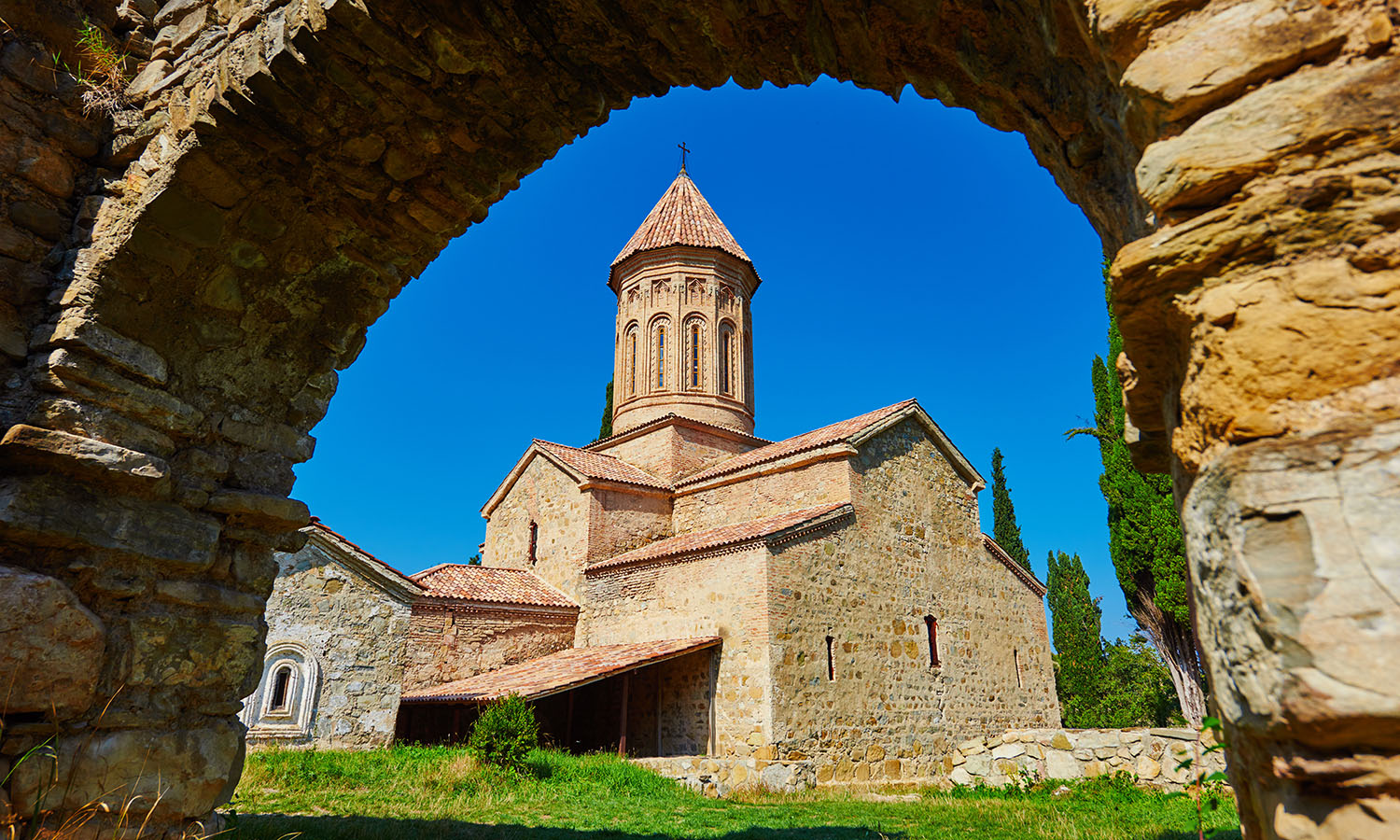
Later you will visit Ikalto Monastery, established by Zenon, one of thirteen Assyrian Fathers in 6th century, his remains are laid in the same Monastery. The complex includes three churches, ruins of old wine cellar and refectory, as well as of the academy.
Further you will visit and view Shuamta Monastery, one of the significant samples of Georgian Christian architecture.
Return to Tbilisi and stay for night.
Tbilisi – Mtskheta – Shio-Mghvime – Ananuri – Tbilisi (179 km)
After the breakfast you will visit Mtskheta, ancient capital city of Georgia (UNESCO monument IVc BC – VI), the city is associated with formation of Georgia statehood, with the history of Christianity. Mtskheta is the place of burial of the great treasure of Old Testament – Elijah the Tishbite’s robe and greatest Christian relic – Christ’s mantle. You will view Svetitskhoveli Cathedral (11th century), the most important among medieval Christian monuments in Georgia. It is surrounded with two-level wall with the towers. Further you will view Jvari Monastery of 6th century, also UNESCO World Heritage Site. It is located on the top of the mountain, facing Mtskheta, it looks over the ancient capital city of Georgia at the confluence of two rivers, with magnificent Svetitskhoveli Cathedral in the middle.
Further you will visit Shiomghvime Monastery of 6th century, one of the most important in Georgia. Its founding is associated with the missionary activities of St. Shio, the disciple of one of thirteen Assyrian Fathers – John of Zedazeni. Here is the grave of St. Shio as well.
Further, we shall visit Ananuri complex located on the background of green slopes and blue Zhinvali Water Reservoir. It was the residence of Aragvi Dukes and consisted of the upper and lower fortresses, with 5-floor pyramidal towers between walls.
From Ananuri we shall visit the farmer’s family, observe dying of the paschal eggs and later return to Tbilisi.
Supper and stay at night in Tbilisi.
Tbilisi – Gelati – Motsameta – Kutaisi (251 km)
In the morning we shall set off to Kutaisi, a city with 3-millennia long history. After arrival you will visit Gelati Godmother Monastic Complex, UNESCO World Heritage Site. You will view the most important education center of medieval Georgia – Gelati Academy.
Further you will visit Motsameta Monastery of 8th century, one of significant monuments of ancient Georgian culture. It is built at the beautiful rocky and forested place. Here are the incorruptible remains of canonized Davit and Constantine.
Night stay in Kutaisi.
Kutaisi – Bagrati – Uplistsikhe – Tbilisi (261 km)
Sin the morning, after the breakfast, you will visit Bagrati Cathedral, the brilliant sample of 10th – 11th century church architecture (the Cathedral is on the List of UNESCO World Heritage Sites), where Georgian monarchs were crowned for many centuries.
In the morning, after the breakfast, you will travel to the city of Gori, the heart of Kartli Province. Here you will visit Uplistsikhe, rock-hewn antique city-monument (1st -2nd millennia BC), walk in its streets, squares, living halls hollowed in the rock and 41-meter-long secret tunnel, view the wine cellars, bread bakeries, drugstore and drainage system of the city. Further you will return to Tbilisi.
Departure
Transportation from the hotel to airport.
Service:
● From / To airport in Tbilisi
● Accommodation
● Transfer According to the program
● English speaking guide
● Meals 6*B, 4*L, 6*D
Visa requirements
Valid passport is necessary of the visitors of any nationality. Individuals with passports issued in USA, Canada, Israel, EU member states, Russian Federation, GCC countries (Bahrain, Kuwait, Oman, Qatar, Saudi Arabia, UAE) etc., do not need visas. In addition, no visa is required for the nationals of CIS countries, with the exclusion of Turkmenistan. Please, see additional information at: https://www.geoconsul.gov.ge/en/visaInformation.
Entry into Georgia
To visit Georgia, you can take a flight. Shota Rustaveli International Airport in Tbilisi, the largest among 3 Georgian airports, offers numerous direct flights from the Europe and Asia. There are 2 more, smaller airports: Batumi and Kutaisi international airports. You can also cross border in several points by train from Yerevan (Armenia) and Baku (Azerbaijan) to Tbilisi. To arrive to Georgia from Turkey, you can cross land border in 3 points: Sarpi, Vale and Kartsakhi. In addition, you can cross border with Armenia in 3 points: Ninotsminda, Geguti and Sadakhlo. Azerbaijan can communicate with Georgia through 2 border posts: Red Bridge and Lagodekhi. Between Russia and Georgia operates one border point, at Larsi, in the vicinity of Stephantsminda.
Climate
Climate in the country is amazingly diverse. Greater Caucasus Range protects Georgia from cold air masses while Caucasus Minor ensures protection of the country from very hot and dry air from the south, as a result, average summer temperature varies between 19OC and 22OC, and winter temperature – from 1.5OC to 3OC.
The best period for travel
With respect of weather, May-June and September-October are the softest and most mellow months in Georgia, with sunny, warm weather. July-August is the best period for walk and tracking.
For the smokers
Smoking is prohibited in any buildings, including the hotel and restaurants. The smokers can use the balconies, terraces or enjoy smoking outdoors.
Water
In Georgia, tap water is safe but if you are used to bottled water, please, be consistent and have bottled water only.
Currency, banks & ATM
In Georgia the official currency is Georgian lari, usually denoted by GEL. Lari consists of 100 tetri. You can change foreign currency at airports, border points, hotels and currency exchange offices. Usually no service fees are paid for currency exchange though recently, in some places the newly opened offices request commissions, so be attentive,
Banks and ATMs are in all large cities but when traveling in countryside make sure that you have sufficient cash.
Electricity
Electricity is 220 V, 50 Hz, with round sockets corresponding to European standards.
Communication
Country telephone code is 00 995. Mobile operators (Silknet, MAGTI and Beeline) cover almost entire territory of the country (with the exclusion of several remote places). You can procure SIM card for the mobile phone with certain quantities of minutes and internet access. In large cities, actually all cafes, bars and restaurants offer Wi-Fi service.
Work hours
Banks open at 10:00 AM and close at 6:00 MP, from Monday to Friday, inclusive. On Saturdays the banks have short working days, from 120:00 AM to 2:00 PM. On Sundays the banks are closed. Most stores open on 10:00 AM and they do not close earlier than at 8:00 PM. Shopping malls work every day, from 10:00 AM to 10:00 PM. There are also food-stores working for 24 hours per day, but this is only in large cities. The museums open at 10:00 AM and work up to 6:00 PM; museums are closed by Mondays. Cafes and bars open at about 11:00 AM and most of them work up to midnight, or until the last guest leaves.
What to wear?
Georgians wear modern western-style clothes. So, you can easily chose the clothes, if you don’t plan to visit the church. For the visit to church you should remember that women mist cover their heads and shoulders and wear long dress while the men must take off their hats and do not wear shorts.
What to taste?
Khachapuri (variations of cheese bread from different regions of Georgia)
Kubdari (minced meat, onion, garlic, pepper, spices, baked in dough)
Khinkali (minced beef and pork with spices in dough, meal from the mountains)
Chkmeruli (chicken roast on ketsi in garlic sauce)
Satsivi
Shashlik (grilled pork or calf)
Chakapuli (lamb pieces, onion, new green sour plums and estragon prepared in white wine)
Pkhali (spinach, chard, cabbage with spices and walnut paste)
Eggplants with walnuts (eggplants roast on the pan dressed with walnut paste with spices_
Imeretian Sulguni and guda cheese
Nadughi in the sulguni sheets (nadughi with mint and sour cream wrapped in sulguni sheets)
Gebzhalia (sulguni pieces boiled in milk and placed in Georgian yoghurt with mint and garlic)
Champignons with cheese (champignon heads roast on ketsi with the grated cheese above).
Tkemali sauce (sauce of sour plums with the young herbs (parsley, mint, dill, coriander), garlic and salt)
Churchkhela (sausage-shaped sweets made of walnuts and grape juice)
Gozinaki (roast walnuts in honey)
And, of course, you must have Georgian meals with wide variety of famous Georgian wines.
Emergency
For all the emergency cases please call 112.
Tour Map
Suggested Tours
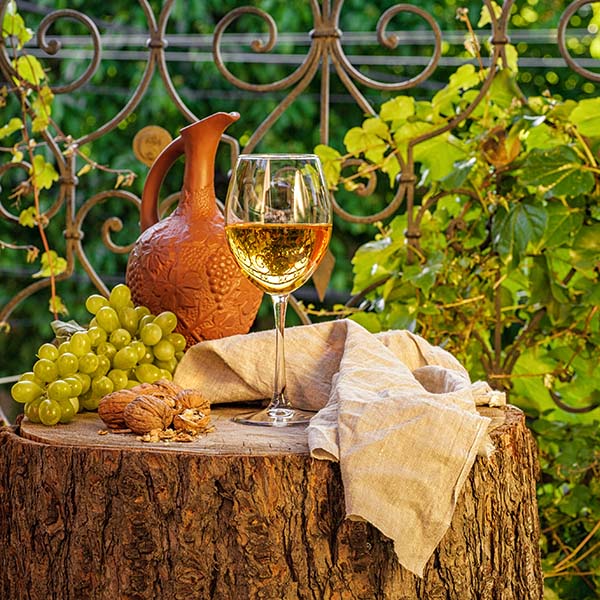
Tour of 16 Wines in the Native Land of the Wine
If you like new experiences and you are interested to find the new taste of wine, degust the national meals and sense the original culture of the nation, this tour is for you. Here you will have the chance to visit regions of Georgia, known as the cradle of wine, view cultural attractions, taste different wines made in kvevri from endemic grape varieties and have special meals characteristic for each of the regions, wide diversity of which distinguishes Georgian cuisine.
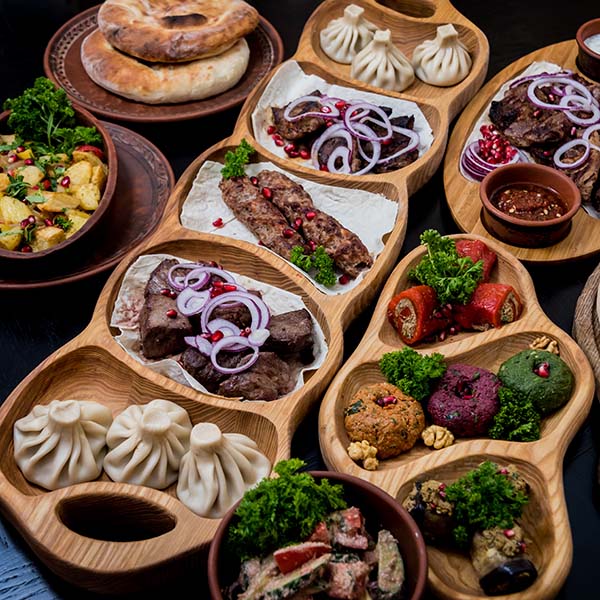
Secrets of the Delicacies of Georgian Cuisine for the Gourmets
If you permanently seek the new culinary delicacies, this tour is for you. In this tour you will taste several absolutely unknown delicious meals every day. Each of these meals is recognized as masterpiece of Georgian cuisine.
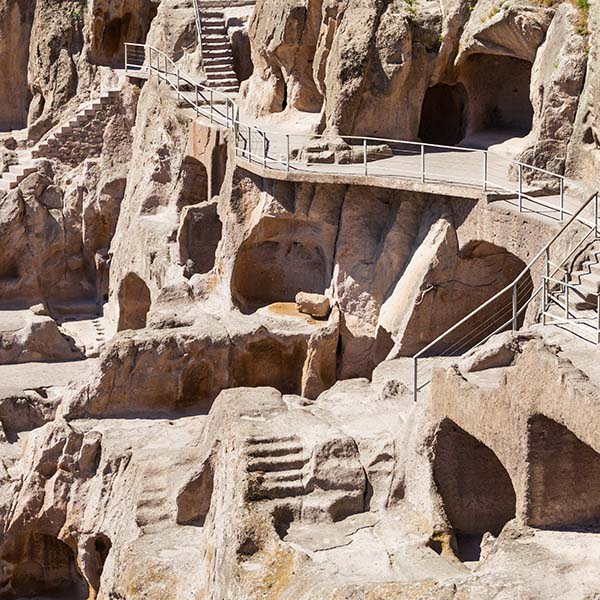
Pearls of South Caucasus – Armenia, Georgia, Azerbaijan
In this tour you will have a chance to visit 3 countries with absolutely different cultures and languages located on the border between Europe and Asia, in South Caucasus; get familiar with the architectural masterpieces and folklore of these countries, taste the meals of 3 different cuisines and enjoy beauty of nature, changing from the sea level to 2200 m altitude.