
Tour Description
Georgia is a country of antiquities, where each and every monument is indeed an outstanding one. And yet, Mtskheta, the ancient capital city of Georgia (IV c BC – VI) is particularly beautiful and UNESCO World Heritage Sites – Svetitskhoveli and Jvari cathedrals are of special significance.
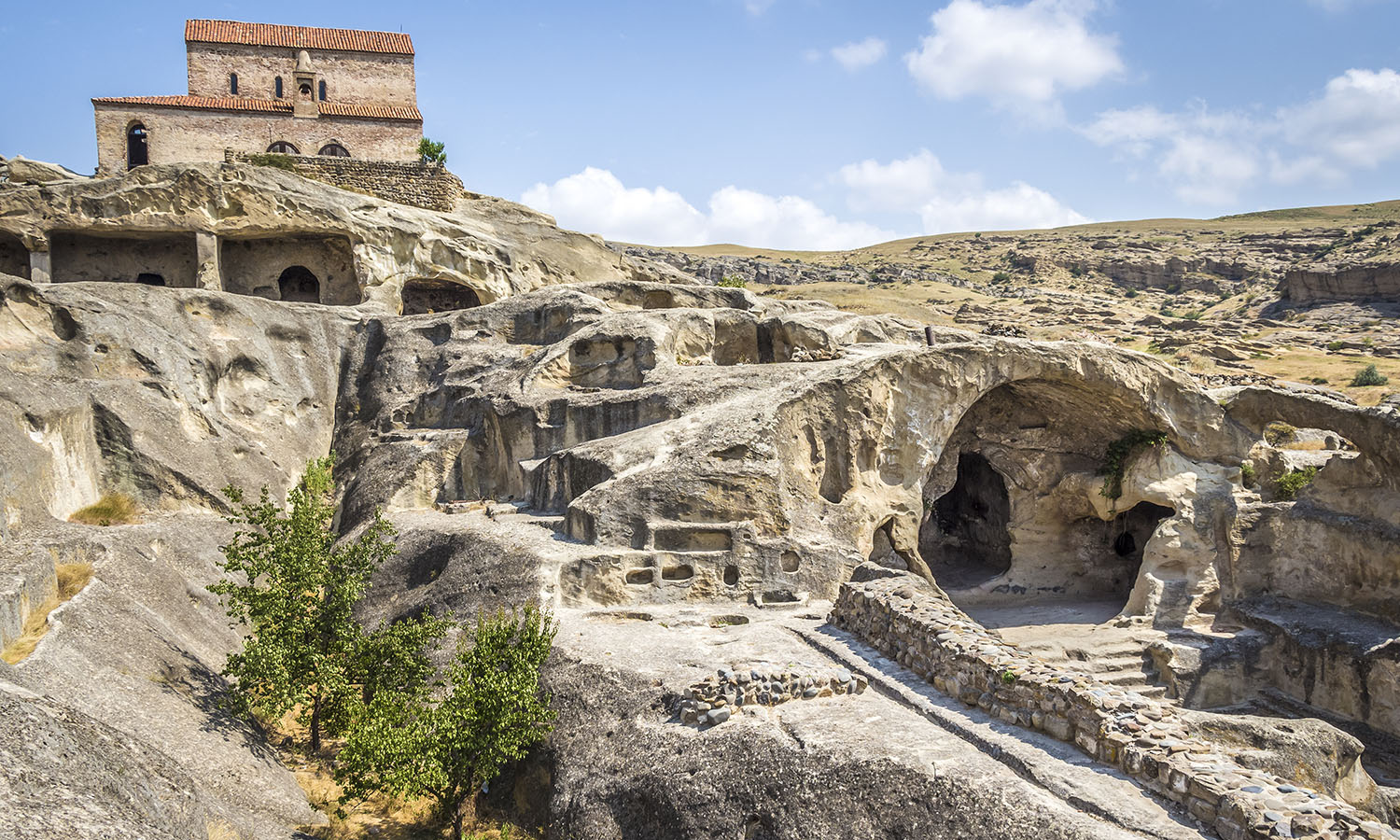
Uplistsikhe, rock-hewn fortified city would delight the admirers of ancient architecture, it is the monument of antique period (1st millennium BC) in Georgia.
Tour Highlights
Gallery



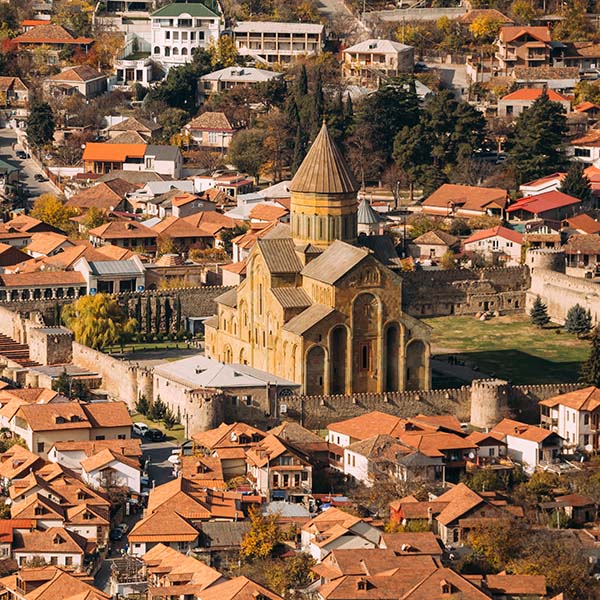
In the course of the tour you will visit Svetitskhoveli Cathedral (11th century) – the most important, among medieval Christian monuments, UNESCO World Heritage Site and the holy place for Georgians, where the Christ’s mantle is preserved. It is located in the center of Mtskheta, surrounded with the two-tier wall with the passes for the guards, embrasures and gun placement, with one cylindrical and 2 square towers built in the wall.
Further you will view Jvari Monastery of 6th century, also UNESCO World Heritage Site. The name of cathedral is related to high wooden cross which was erected on this place by King Mirian. Jvari Monastery is located on the top of the mountain, facing Mtskheta and looks over the ancient capital city of Georgia at the confluence of two rivers, with magnificent Svetitskhoveli Cathedral in the middle.
Further we shall head to the city of Gori, the heart of Kartli Province. Here we shall visit Uplistsikhe, rock-hewn antique city-monument (1st -2nd millennia BC), walk in its streets, squares, living halls hollowed in the rock and 41-meter-long secret tunnel, view the wine cellars, bread bakeries, drugstore and drainage system of the city. Further we shall visit the home museum of the founder of the Soviet Union, dictator Ioseb Stalin, there we shall see the house where the dictator was born and where he has spent his childhood. There are maintained the articles associated with that period. Further we shall return to Tbilisi.
Service:
● Transfer According to the program
● English speaking guide
● Meals 1*L
Visa requirements
Valid passport is necessary of the visitors of any nationality. Individuals with passports issued in USA, Canada, Israel, EU member states, Russian Federation, GCC countries (Bahrain, Kuwait, Oman, Qatar, Saudi Arabia, UAE) etc., do not need visas. In addition, no visa is required for the nationals of CIS countries, with the exclusion of Turkmenistan. Please, see additional information at: https://www.geoconsul.gov.ge/en/visaInformation.
Entry into Georgia
To visit Georgia, you can take a flight. Shota Rustaveli International Airport in Tbilisi, the largest among 3 Georgian airports, offers numerous direct flights from the Europe and Asia. There are 2 more, smaller airports: Batumi and Kutaisi international airports. You can also cross border in several points by train from Yerevan (Armenia) and Baku (Azerbaijan) to Tbilisi. To arrive to Georgia from Turkey, you can cross land border in 3 points: Sarpi, Vale and Kartsakhi. In addition, you can cross border with Armenia in 3 points: Ninotsminda, Geguti and Sadakhlo. Azerbaijan can communicate with Georgia through 2 border posts: Red Bridge and Lagodekhi. Between Russia and Georgia operates one border point, at Larsi, in the vicinity of Stephantsminda.
Climate
Climate in the country is amazingly diverse. Greater Caucasus Range protects Georgia from cold air masses while Caucasus Minor ensures protection of the country from very hot and dry air from the south, as a result, average summer temperature varies between 19OC and 22OC, and winter temperature – from 1.5OC to 3OC.
The best period for travel
With respect of weather, May-June and September-October are the softest and most mellow months in Georgia, with sunny, warm weather. July-August is the best period for walk and tracking.
For the smokers
Smoking is prohibited in any buildings, including the hotel and restaurants. The smokers can use the balconies, terraces or enjoy smoking outdoors.
Water
In Georgia, tap water is safe but if you are used to bottled water, please, be consistent and have bottled water only.
Currency, banks & ATM
In Georgia the official currency is Georgian lari, usually denoted by GEL. Lari consists of 100 tetri. You can change foreign currency at airports, border points, hotels and currency exchange offices. Usually no service fees are paid for currency exchange though recently, in some places the newly opened offices request commissions, so be attentive,
Banks and ATMs are in all large cities but when traveling in countryside make sure that you have sufficient cash.
Electricity
Electricity is 220 V, 50 Hz, with round sockets corresponding to European standards.
Communication
Country telephone code is 00 995. Mobile operators (Silknet, MAGTI and Beeline) cover almost entire territory of the country (with the exclusion of several remote places). You can procure SIM card for the mobile phone with certain quantities of minutes and internet access. In large cities, actually all cafes, bars and restaurants offer Wi-Fi service.
Work hours
Banks open at 10:00 AM and close at 6:00 MP, from Monday to Friday, inclusive. On Saturdays the banks have short working days, from 120:00 AM to 2:00 PM. On Sundays the banks are closed. Most stores open on 10:00 AM and they do not close earlier than at 8:00 PM. Shopping malls work every day, from 10:00 AM to 10:00 PM. There are also food-stores working for 24 hours per day, but this is only in large cities. The museums open at 10:00 AM and work up to 6:00 PM; museums are closed by Mondays. Cafes and bars open at about 11:00 AM and most of them work up to midnight, or until the last guest leaves.
What to wear?
Georgians wear modern western-style clothes. So, you can easily chose the clothes, if you don’t plan to visit the church. For the visit to church you should remember that women mist cover their heads and shoulders and wear long dress while the men must take off their hats and do not wear shorts.
What to taste?
Khachapuri (variations of cheese bread from different regions of Georgia)
Kubdari (minced meat, onion, garlic, pepper, spices, baked in dough)
Khinkali (minced beef and pork with spices in dough, meal from the mountains)
Chkmeruli (chicken roast on ketsi in garlic sauce)
Satsivi
Shashlik (grilled pork or calf)
Chakapuli (lamb pieces, onion, new green sour plums and estragon prepared in white wine)
Pkhali (spinach, chard, cabbage with spices and walnut paste)
Eggplants with walnuts (eggplants roast on the pan dressed with walnut paste with spices_
Imeretian Sulguni and guda cheese
Nadughi in the sulguni sheets (nadughi with mint and sour cream wrapped in sulguni sheets)
Gebzhalia (sulguni pieces boiled in milk and placed in Georgian yoghurt with mint and garlic)
Champignons with cheese (champignon heads roast on ketsi with the grated cheese above).
Tkemali sauce (sauce of sour plums with the young herbs (parsley, mint, dill, coriander), garlic and salt)
Churchkhela (sausage-shaped sweets made of walnuts and grape juice)
Gozinaki (roast walnuts in honey)
And, of course, you must have Georgian meals with wide variety of famous Georgian wines.
Emergency
For all the emergency cases please call 112.
Tour Map
Suggested Tours

Tbilisi Tour (complete)
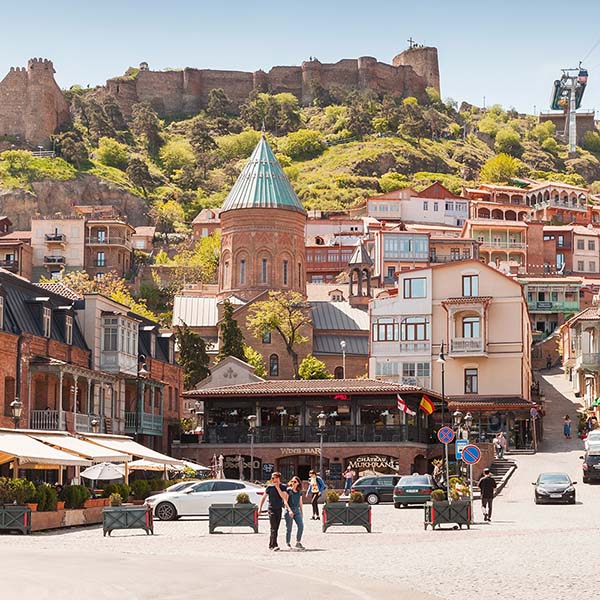
You will view the places of interest in Old Tbilisi, Christian churches, mosque, synagogue. You will have walk in the twisted lovely streets of Old Tbilisi, view unique, original architecture of Old Tbilisi and sense the spirit of old, multinational, multicultural city; you will visit the National Museum and view the ancient unique exhibits, starting from antiquity and Colchis epoch up to present.
Tbilisi Tour (standard)
In the course of this tour you will view the places of interest of Old Tbilisi, Christian churches, mosque, synagogue. You will have a walk in the twisted lovely streets of Old Tbilisi, view unique and original architecture of Old Tbilisi and sense the spirit of ancient, multinational and multicultural city.
Tbilisi – Mtskheta – Tbilisi
You will visit Mtskheta, the ancient capital city of Georgia, the city is 24 centuries old. You will view the masterpieces of Georgian architecture: Jvari Monastery of 6th century located on the top of the mountain, overlooking Mtskhea at the confluence of Kura and Aragvi rivers and pride of entire Georgia, Svetitskhoveli Cathedral of 11th century.